

Choosing the Right Line Trimmer or Brush Cutter - Petrol or Battery
Petrol or Battery? What do you need to consider when choosing your next line trimmer or brush cutter?
Should I get a petrol or battery line trimmer?
With motor vehicles, these days the big decision is whether to go for internal combustion engines or electric motors. That’ll often be a personal, lifestyle choice.
Not so much with line trimmers. It really is a case of the right power tool for the job.
The case for Petrol-powered trimmers
Petrol-powered trimmers come in a variety of engine sizes and power outputs. Much like cars or motorbikes.
Smaller CC ratings* suit lighter jobs, like grass trimming and edging, while the higher CCs are a bit gruntier and better for cutting through taller, coarser grasses, weeds and scrub.
Powerful 4 stroke engines
Honda engines are fairly legendary things, proven and refined, and engineered for smooth power delivery with plenty of torque.
They’re also exclusively 4-stroke, which means there’s no mucking around with pre-mixing fuel and oil, like you would have to with a 2-stroke trimmer.
They all feature ‘one pull’ system for easy starting, and all are 360 degree rotatable, too, so you can get at the grass from any angle.
Honda 4 strokes are also quiet, efficient and economical.
All day workhorses
One of the big advantages of petrol trimmers is they can keep running for as long as you have fuel on hand – this makes them ideal for covering large areas, or for long, even all-day work sessions. Commercial operators tend to favour petrol models for that reason alone.
It’s worth pointing out here that if you are going to be using for extended periods, look for a model with vibration dampening – it’s more comfortable to use and will reduce fatigue when you’re working hard. You’ll still know you’ve done some work but it won’t be straight to bed.
Alongside their dedicated petrol trimmer range, Honda has a clever bit of equipment called the Versatool – a line trimmer that’s also a hedge trimmer, a leaf blower and more.
Maintenance matters
Looking after equipment is always important – with all petrol gear, regular servicing will ensure it’s always running smoothly and safely, and will have a long and useful operating life.
You can do the maintenance yourself, getting parts when you need them from your Honda Outdoors dealer, or get them to do the service and tune ups for you. They’re good like that.
The case for battery powered trimmers
Now let’s look at the benefits of battery power.
The first, big one is simply convenience. They’re good to go straight out of the shed – as long as you’ve remembered to charge the battery. There’s no priming or refuelling or pulling of start cords, they’re off and running at the push of a button.
Secondly, they’re lighter than petrol models. They’re also quieter, with lower vibration, so arguably a bit more comfortable to use. And they don’t require regular servicing.
Sounds like a no-brainer? Well… there are a few things to consider.
The big one is the battery itself. Battery tech and engineering have advanced to the point where some battery trimmers are as powerful as petrol models.
Capacity = Run time
But line trimming is a high drain use, so check the battery’s capacity – the higher the amp hours, the longer the run time, as a general rule.
All Honda cordless trimmers use universal 36 volt batteries so you can use them on other Honda cordless equipment – Honda has a range of battery AMP sizes.
In any case, run time isn’t much of an issue if you have a backup battery – so you can be using one while the other is recharging. In theory you could do this all day long, although most cordless trimmers aren’t designed for such intensive continuous use.
If you’re going to be working all day, if you’re a commercial user going from job to job, covering big areas or dealing with really tough foliage – then a battery powered trimmer is probably not the best choice. They’re not as torquey as petrol models, and they’re not engineered for heavy duty operation.
Otherwise, for everything else, they’re really very good.
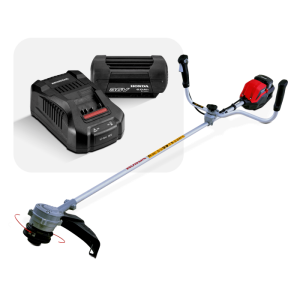 HHT36 Battery Brush Cutter Kit (Includes 6Ah Battery & Charger)
Engine: Brushless DC 1.6kW
Weight: 6.5 kg (excluding battery)
Blade: Yes (3 tooth)
$547 $1,047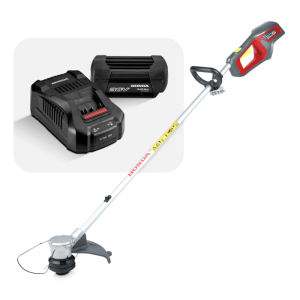 HHT36BXB Battery Lawn Trimmer Kit (Includes 4Ah Battery & Charger)
Engine: Brushless DC 1.2kW
Weight: 3.3kg (excluding battery)
Blade: No
$647 $847 HHT36BXB Battery Lawn Trimmer
Engine: Brushless DC 1.2kW
Weight: 3.3kg (excluding battery)
Blade: No
$449


 HHT36 Battery Brush Cutter
Engine: Brushless DC 1.6kW
Weight: 6.5 kg (excluding battery)
Blade: Yes (3 tooth)
$549


